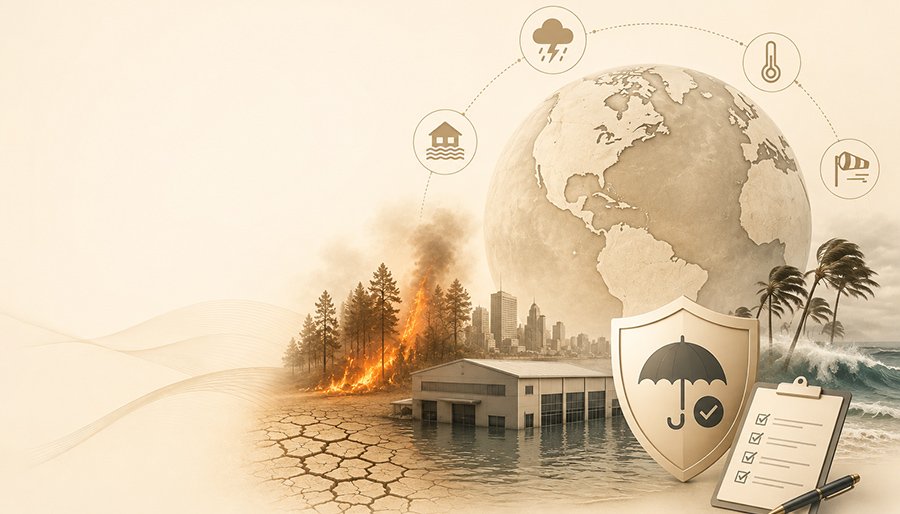
Climate Risk Is Becoming an Immediate Underwriting Issue
Climate change is increasingly influencing the frequency, severity and location of insured losses.
The World Meteorological Organization reported in March 2026 that the years from 2015 to 2025 were the hottest eleven-year period on record. Extreme heat, heavy rainfall and tropical cyclones continued to cause major human and economic disruption.
The WMO’s May 2026 climate update also states that global temperatures are likely to remain at or near record levels over the coming years. It estimates a 91% probability that at least one year between 2026 and 2030 will temporarily exceed 1.5°C above the pre-industrial average.
For reinsurance, climate risk is not limited to catastrophe treaties. It affects property values, engineering projects, agriculture, energy generation, marine operations, supply chains and business interruption.
Historical loss records may become less reliable where hazard patterns are changing. Underwriters therefore need to consider current exposure data, construction quality, flood and heat resilience, maintenance standards, emergency planning and the availability of reliable catastrophe modelling.
Climate adaptation is also becoming increasingly important. Stronger construction, better drainage, early-warning systems, resilient power supply and effective business-continuity planning can materially influence the quality of a risk.
The underwriting question is no longer whether climate change affects the portfolio. It is how quickly exposure, pricing and risk controls are being adjusted to reflect it.